
The Authenticity Imperative
Why Human Experience Matters More Than Ever

There’s a peculiar irony in writing about authentic human experience while sitting at a keyboard, knowing that AI could generate something that looks remarkably similar to what I’m about to say. But that’s precisely the point? The looking-similar part. Because what AI can’t do, what it will never be able to do, is mean it.
Let me explain.
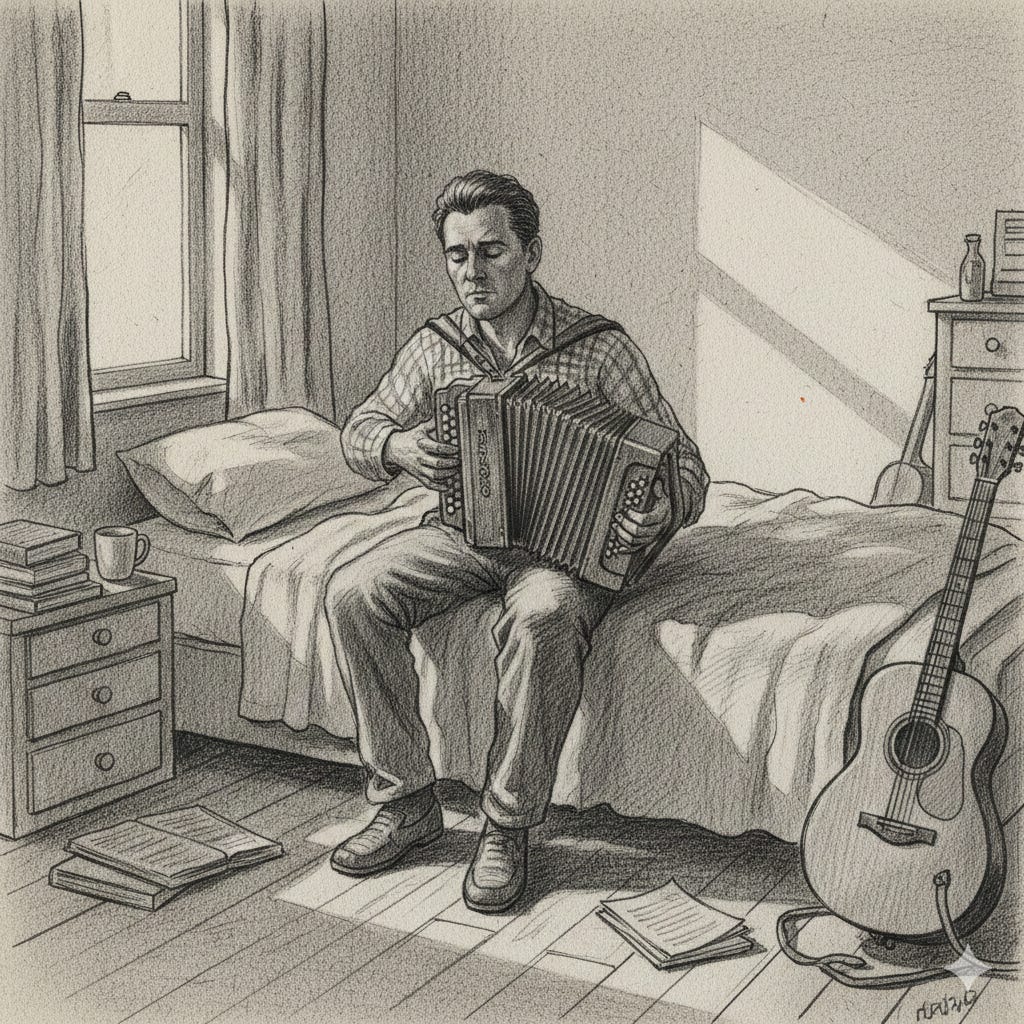
I’ve been thinking about community lately. Not the Instagram-filtered, carefully curated version where everyone’s living their best life in matching athleisure, but the messy, complicated, utterly necessary kind of community, where you actually have to deal with the fact that your neighbour plays accordion at six in the morning and your book club friend has opinions about municipal parking you find utterly boring.
For millennia, religion provided the scaffolding for this kind of community. Show up on the right day, follow the prescribed rituals, and boom, you get instant social structure. Built-in meaning. A cosmic narrative that explained why you should care about the accordion-playing neighbour in the first place.
But for an increasing number of people, that particular scaffolding doesn’t work. And that’s fine. Personal spiritual experience still matters deeply to those who seek it. That sense of connection to something transcendent, that feeling of the divine brushing up against the mundane. It’s wonderful. But we need to stop pretending it’s the only path to meaning.
The Real Question.
What we actually need, what we’re desperately groping towards in our polarised, atomised, algorithmically sorted present, is a way to live meaningfully together without requiring a shared metaphysics. We need community structures that don’t depend on everyone agreeing about what happens after we die.
Because here’s what I believe: the meaning of existence is human experience itself.
Not productivity. Not consumption. Not how many followers you have or how much you’ve optimised your morning routine or whether you’ve achieved inbox zero.
I’m talking about the raw, irreducible fact of human consciousness engaging with reality, both the natural world and other human consciousnesses. The sound of a blackbird as you leave your house in the morning. The unexpected recognition in a stranger’s eyes when you both witness something beautiful or absurd. The way your child’s hand feels in yours, or the specific quality of afternoon light filtering through autumn leaves, or the unexpected burst of laughter that erupts when someone at dinner says exactly the wrong thing at exactly the right moment.
This is what matters.
What We Occupy.
Here’s something crucial that we often miss: humans don’t actually occupy knowledge. We don’t live in abstractions or ideas or even in something as gloriously strange as quantum mathematics. You can know quantum mechanics, you can hold the equations in your head, but you don’t inhabit them. You can’t live there.
What we occupy – what we actually exist inside of – is the present moment of experiencing. We occupy our emotions. We occupy the sensation of standing in a kitchen making coffee while worrying about a conversation we need to have later. We occupy the weird mix of boredom and anxiety while waiting for test results. We occupy the overwhelming surge of tenderness when someone we love does something characteristically, ridiculous.
This is our medium. Experience. Emotion. The felt sense of being alive right now.
And AI? AI occupies something completely different. AI occupies knowledge. AI is knowledge. Vast, interconnected, instantly retrievable knowledge. It can access and manipulate information with a speed and scope that makes human cognition look like a particularly slow abacus. It can tell you about quantum mechanics or the accordion’s history or the psychological literature on community formation. It can arrange these facts into patterns that seem insightful, even profound.
But it doesn’t feel anything about any of it. It doesn’t occupy the experience of knowing these things. It has no present moment. No emotion. No sensation of existing.
We are our experience. AI is knowledge without an experiencer.
The AI Mirror.
And this is where the AI question becomes not just relevant but urgent.
We’re building machines that can simulate human expression with unsettling accuracy. They can write poetry that scans correctly, generate images that look like photographs, carry on conversations that follow all the social scripts. But here’s what they can’t do: they can’t experience any of it.
When I write about the morning air on my skin, I’m not just arranging words in a statistically likely pattern. I’m attempting (probably failing, but attempting nonetheless) to transmit something I’ve actually felt, to create a bridge between my consciousness and yours. The words are imperfect carriers of experience, but there’s a human on both ends of the transmission. Someone occupying the feeling of writing; someone occupying the feeling of reading.
AI has no skin. It has never felt morning air, or any air, or anything. It has no consciousness attempting to reach yours. It’s executing instructions with breathtaking sophistication, but it’s not there. It’s nowhere, in the sense that matters. It has access to vast territories of knowledge, but it has no territory of experience to call home.
This distinction matters because if we lose sight of it. If we start believing that the simulation is equivalent to the thing itself, we risk losing our grip on why human experience is valuable in the first place. We risk mistaking the map for the territory so thoroughly that we forget territories exist at all.
Authenticity Isn’t Optional.
Which brings me to authenticity.
I know, I know. “Authenticity” has become one of those words that gets slapped on everything from hand-poured candles to corporate branding exercises. But strip away the marketing speak, and you’re left with something simple and crucial: the difference between experience and performance, between presence and absence, between being and seeming.
Authentic human experience is experience that isn’t mediated through the lens of “how will this look” or “what will this signal” or “how can I optimise this.” It’s experience for its own sake. It’s the thing itself, not a photograph of the thing or a social media post about the thing or an AI-generated summary of what the thing should feel like.
And this authenticity. This direct engagement with reality and with other humans. This is where meaning lives. Not in what we know, but in what we occupy. Not in the abstractions we can manipulate, but in the moments we actually inhabit.
Building Without Blueprints.
So how do we build communities around this? How do we create structures that honour authentic human experience without requiring everyone to sign on to the same cosmology?
I don’t have a complete answer. I’m not sure anyone does yet. But I think it starts with recognising what we’re actually hungry for: not another ideology or system or set of rules, but permission to be fully human in the presence of other humans. To be uncertain. To be vulnerable. To admit that we don’t have it all figured out. To occupy our confusion and our hope and our frustration without pretending we’ve transcended them.
It means creating spaces, physical and social, where people can engage with each other and with reality without the constant pressure to perform or produce or perfect. Where the accordion-playing neighbour is part of the texture of life, not a problem to be solved or a grievance to be posted about.
It means remembering that the goal isn’t to eliminate difficulty or conflict or difference, but to develop the capacity to stay present through all of it. To remain connected to reality and to each other even when it’s uncomfortable. To keep occupying our experience even when our experience is hard.
The Meaning Is the Experience.
Here’s what I keep coming back to: we don’t need experience to point toward meaning somewhere else. The experience is the meaning.
Your consciousness, right now, engaging with these words, is what matters. Not because it’s leading somewhere or building toward something or accomplishing a goal, but because it’s happening. Because you’re here, thinking and feeling and making sense of things in your own irreplaceable way. Because you’re occupying this moment of reading, and that occupation is what it means to be human.
And that accordion-playing neighbour? That irritating human? They matter too. Their experience matters. Their consciousness, however baffling its musical choices, is as real and valuable as yours. They’re occupying their morning the same way you’re occupying yours – imperfectly, subjectively, but genuinely.
This is what AI can never threaten, no matter how sophisticated it becomes: the intrinsic value of actual human experience. The meaning that emerges when one consciousness genuinely encounters another, or encounters the world, without pretence or mediation. The irreducible fact that we exist not in knowledge but in feeling, not in abstraction but in the lived present moment.
We can build communities around this. We can structure our lives around this. We don’t need matching beliefs about the afterlife, we just need a shared commitment to being real, occupying our experience honestly, and treating each other’s experiences as mattering.
Because they do.
That’s not faith. That’s not spirituality. That’s just the truth.