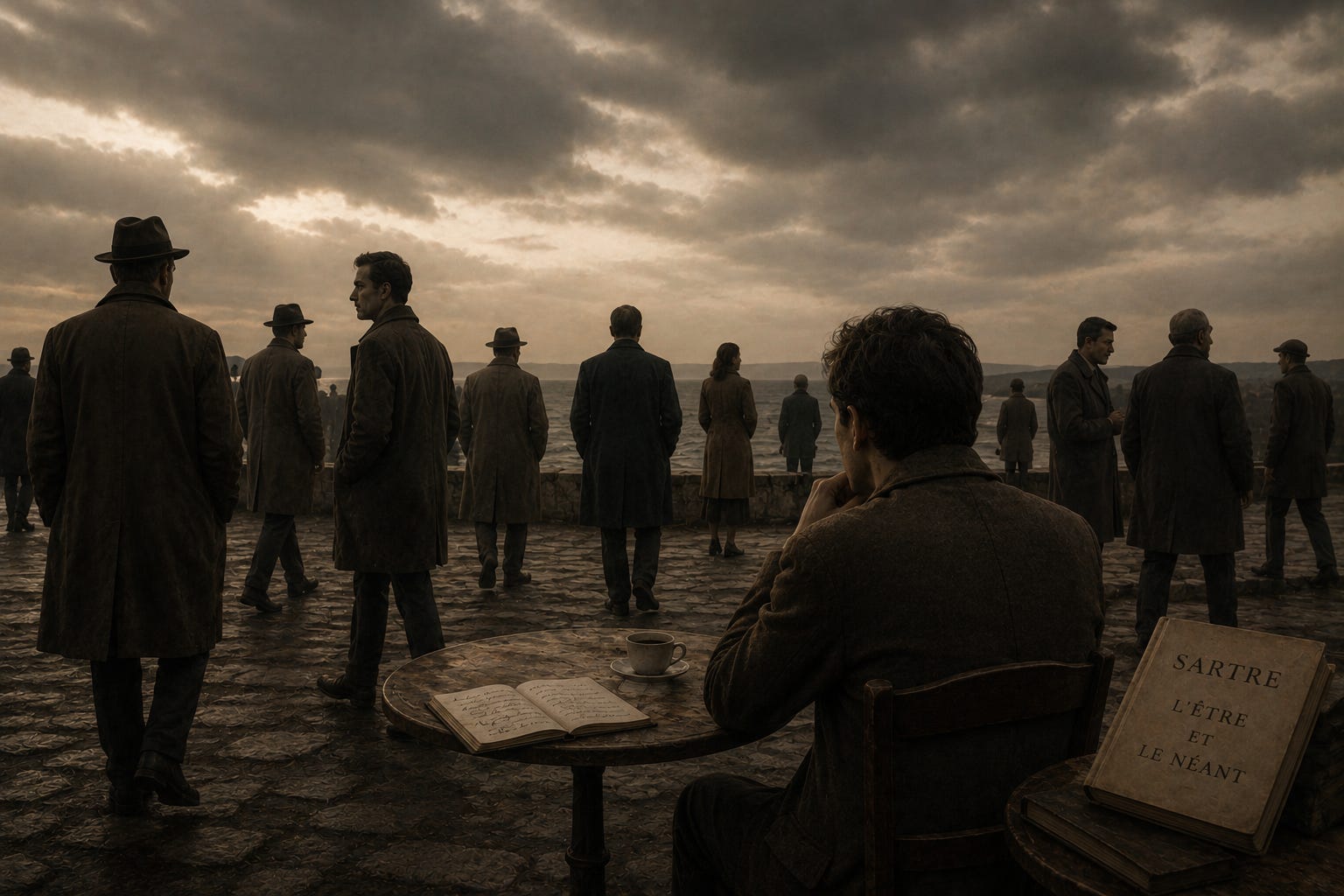
Is Hell Other People?
On Sartre, and the ground from which something else can grow.
I read Huis clos – No Exit by Jean Paul Sartre – in French, in France, some time ago.
There’s a particular value to reading a philosopher in his own language, in his own country. He wrote: L’enfer, c’est les autres – Hell is other people. It doesn’t sound like an aphorism. It sounds like a diagnosis, delivered by a man who has stopped hoping.
What struck me then – what strikes me still – is that Sartre wasn’t being cynical. He was being accurate. He had noticed something true about the structure of experience. Under the gaze of another, I’m no longer the free centre of my world; I become an object in someone else’s world. I acquire an outside I cannot see and cannot govern. Someone is making me mean something, in a mind I have no access to, and there’s nothing I can do about it.
Sartre gave me the seriousness of freedom, the refusal of comfortable illusions, the insistence that we aren’t furnished with a nature but have to make one. He taught me that bad faith is the ordinary weather of a human life and that most of what we call character is a series of small evasions. None of that has ever left me. It is in me, the way the soil is in the tree.
But soil is not the tree.
And here is where I began, slowly, to feel the ground shifting.
Because Sartre’s account of the other is complete. In his world, the encounter has only two positions. Either I am the subject and you are the object I appropriate, or you are the subject and I am the object you appropriate. The look goes one way or the other. Two freedoms cannot both be free in the same room; one of them is always being turned to stone. Love, in that world, is a doomed project.
For a time I accepted this as a truth mature people have to accept.
And then it stopped being true.
Not because I argued my way out of it. Because I kept meeting people. And what happened in the meetings didn’t fit the account. There were rooms I walked into and left different – not diminished, not objectified, but somehow more myself than when I entered. There were people who saw me and I didn’t turn to stone under it. There were conversations that weren’t a contest of gazes at all, but something else entirely, something with a life of its own – a third thing, alive between us, that neither of us had brought in and neither of us could take away. I have had friendships that made me. I have been disclosed by other people. And no honest phenomenology of my own life could describe that as hell.
So what went wrong in the locked room?
I think it is this. Sartre’s other is always the other for a consciousness that will not let go of its sovereignty. His analysis is not a description of the encounter as such. It is a description of the encounter as experienced by an ego determined to remain the centre of its own world. Of course the other is hell, if I insist on owning my place. Of course the gaze is a threat, if my project is total mastery of the meaning of my life. Of course two freedoms cannot share a room, if a room can only have one master.
But that “if” isn’t a law of being. It’s a posture. And it can be relinquished.
This is what I mean when I say existentialism was the earth and not the tree. Sartre saw the mechanism perfectly and misread the verdict. The dispossession is real – he was right, I’m undone by the other, I do lose my sovereignty, my world is taken from me. Every word of that stands. What he didn’t see is that the dispossession is the gift. The losing of my place is the opening of a place larger than mine. He got as far as the wound and called it the end of the story. But it’s the beginning.
To go further, I had to go elsewhere – and, in a sense, further east.
Martin Buber understood that the relation is not in me and not in you but genuinely lives in the between: a real thing, born of the meeting, belonging to neither. Mikhail Bakhtin understood why I could never own you – because I cannot even see myself whole, my own horizon closes behind my back, and only you, standing where I cannot stand, can finish the picture I can never finish alone. Which means, in the meeting, I become for you the very thing I can never be for myself. And Nishida understood the hardest and most beautiful part: that the self is most fully itself in the moment it stops clutching itself. That I become I by emptying toward a Thou. That the meeting happens within something – a place that holds us both, that neither of us built and neither of us owns.
Put those together and Sartre’s locked room dissolves – not by being refuted, but by being outgrown. The look is still there. The dispossession is still there. But they are no longer the last word. They are the price of admission to something Sartre’s ontology had no room for: a genuine between, a real encounter, a place made of two people that is more than either.
This is the movement that Logontology is trying to name. Not the abandonment of existentialism but its completion – an affirmative existentialism, which keeps the honesty and refuses the despair. Sartre gave us the courage to look at what is actually there. I simply think that when we look, unflinchingly, with all the rigour he demanded, we find something more than he found.
The other withdraws from me, always. There’s a depth in you I will never reach, a life that was running long before it crossed my threshold and will run on long after. Sartre would call that the wall between us. I have come to think it’s the door.
And so the film below, which asks the question in Sartre’s own words, and answers it in mine.
Who are these people: the strangers, the needy, the difficult, the beloved? Not types. Not a taxonomy of the poor and the rich and the caring, sorted into drawers, each label breaking the moment a real face looks up from under it. The other is a place: a place within which I am disclosed, as I am a place within which they are disclosed. In the encounter I become the other for the other. A place within another’s place.
Hell is other people because they take our place from us.
And grace is other people, for exactly the same reason.
If this way of thinking interests you, its fuller architecture is in In the Becoming (Arvan Press, 2025). The film is part of an ongoing series on Logontology – an affirmative existentialism concerned with becoming, place, and the ways meaning discloses itself in the world.