

I Began Where Many Do
Dissatisfied With Religion But Unconvinced By Atheism

The dissatisfaction with religion came first, and it was fairly ordinary. It was not trauma. It was not dramatic rupture. It was just the slow discovery that the answers I’d been given didn’t quite fit the questions I was asking. The doctrines were way to tidy. The God on offer too definite, too nameable, too easily recruited in support of whatever the institution needed him to support. Something in me kept pulling me back. It wasn’t disbelief exactly. It was more like an allergy to conclusion.
And then atheism crept up on me. When it came it was sharp. It had a disturbing clarity. The world is what it is, matter and motion, and the religious instinct is a mistake – useful once, but now a distraction. I could see the argument. It seemed, for a while, a very short while, to be the grown-up position.
But that didn’t hold either.
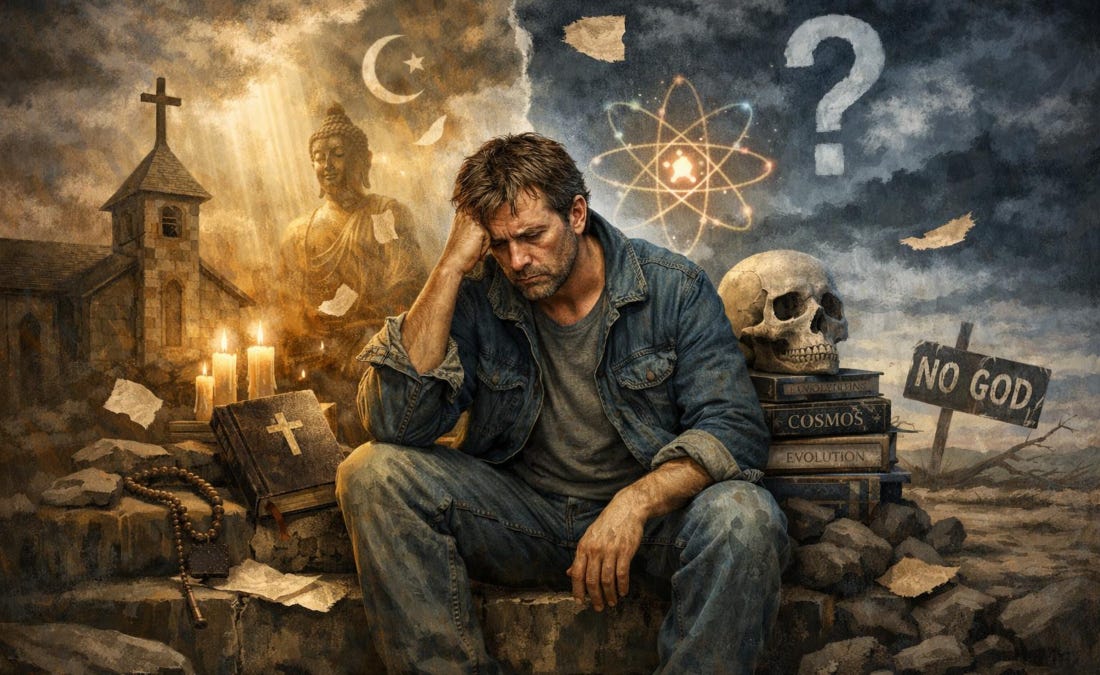
I don’t think it was because I needed the comfort of believing. That explanation – that religious people believe because they can’t face the alternative – always struck me as condescending. It mistakes a preference for consolation, which some people do have, for a need that everyone must have, which is quite different. I wasn’t afraid of a universe without God – although that was a bleak thought. I was just not convinced that such a universe existed.
The problem was with what atheism was so certain it had disposed of.
The materialist picture: everything reducible to physical process, consciousness a late arrival and possibly an illusion, meaning a human projection onto a fundamentally meaningless substrate… These ideas kept running into the same difficulty. The materialist picture couldn’t account for itself. The moment you take seriously the claim that all mental events are simply brain events, you’ve undermined the reasoning that got you there. The argument erases its own foundation.
I’m not making a case for God. Not yet. I’m just noting that the confident dismissal of the question seemed to require a kind of selective inattention that I found, in its own way, as unsatisfying as the religion it replaced.
So I was in between. Which is uncomfortable, but also, I think, honest.
The space between is not nothing. It’s where the interesting questions live. Questions that religion once held but often stopped asking, and that atheism considers answered but hasn’t actually answered. Questions like: why is there something rather than nothing? What is consciousness, really? Is meaning something we make, or something we find, or some third thing that the made/found distinction can’t quite capture? What does it mean to say that something matters?
These are not questions with obvious answers. But they’re also not questions you can simply set aside. They keep coming back. They’re what philosophy has always been trying to get at.
Logontology is, in part, my attempt to stay in that space without flinching.
The world is not a fixed thing with a fixed explanation. It is an unfolding. And we are part of the unfolding. We aren’t spectators, we’re not consumers of meaning, but participants in a process that is genuinely open, genuinely unfinished.
That’s where I started. Dissatisfied, unconvinced, and attentive.
It turned out to be enough to move on with.